
Trump Renamed AI "Super Intelligence": What It Means for Your Business
The U.S. government now calls AI "Super Intelligence," and the biggest AI labs signed a voluntary safety accord. Here is what the order and the accord actually do, and what they mean for a small business.

Shajeed I.
Founder
Key takeaways
- On September 29, 2026, an executive order told U.S. federal agencies to say "Super Intelligence" (SI) instead of "artificial intelligence" (AI).
- It changes words, not laws. Regulations, contracts, and the legal definition stay as they are for now.
- The same day, Google, Anthropic, Meta, OpenAI, xAI, and Nvidia signed a voluntary accord promising four layers of safety checks, with no penalties.
- Nothing changes for Canadian businesses, and almost nothing for U.S. ones. The tools are the same tools.
- Only about one in five Canadian businesses uses AI to serve customers, so the real question is whether it is working in yours.
What did the "Super Intelligence" executive order do?
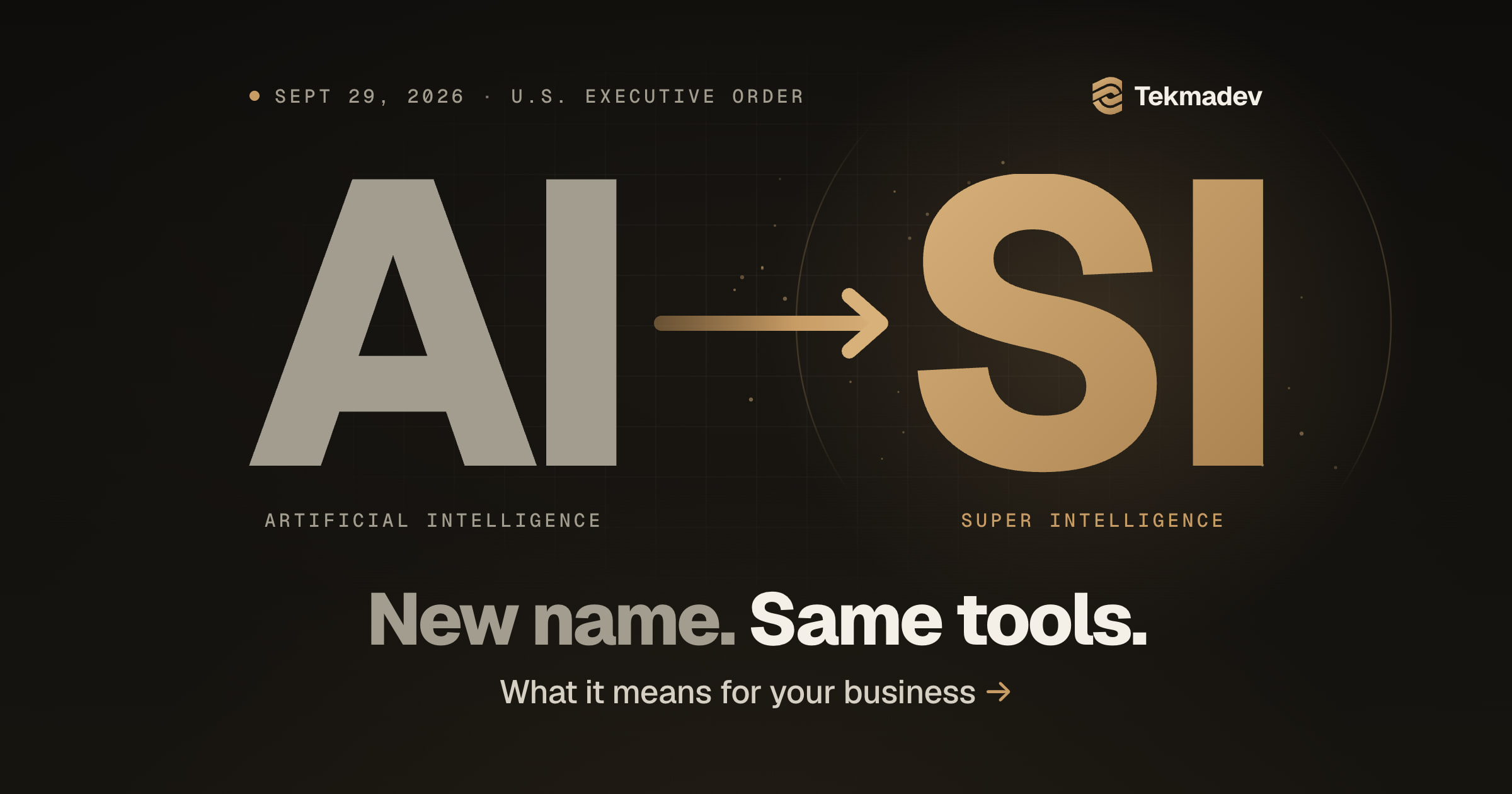
On September 29, 2026, President Trump signed an executive order called "Inaugurating the Era of Super Intelligence." It tells U.S. federal agencies to say "Super Intelligence" and "SI" instead of "artificial intelligence" and "AI" on their websites, in their reports, and in official communications. It changes the words, not the law. The same day, six AI and chip companies signed a voluntary White House accord that promises layered safety checks on their most advanced models. Neither one changes the rules a small business works under.
What happened, day by day
The rename moved fast. It went from a line in a speech to a signed order in one week.
| Date | What happened |
|---|---|
| September 22, 2026 | At the United Nations General Assembly, Trump said U.S. government documents would switch from "artificial" to "super." |
| By September 23, 2026 | The State Department told diplomats in its international organizations bureau to use "super intelligence" in their communications. |
| September 29, 2026 | Trump signed the executive order "Inaugurating the Era of Super Intelligence." |
| September 29, 2026 | The leaders of Google, Anthropic, Meta, OpenAI, xAI, and Nvidia signed a voluntary White House accord on frontier SI safety. |
What does the executive order actually require?
The order is short. Here is what it does:
- New words for agencies. Federal agencies use "Super Intelligence" and "SI" in official correspondence, public communications, websites, reports, and policy documents.
- The old words are out. As far as the law allows, agencies are told not to acknowledge the terms "artificial intelligence" and "AI."
- Old paperwork stays as it is. Regulations already issued, earlier presidential actions, contracts, grants, and historical documents do not have to be rewritten.
- The legal definition stays for now. The definition already in U.S. law (15 U.S.C. 9401(3)) still applies until the President or Congress changes it.
- A new definition is coming. The Assistant to the President for Science and Technology has 60 days to propose legislative language for a federal definition of SI, and to say whether it should go beyond the current one.
So the order renames the technology inside the U.S. federal government. It does not ban anything, fund anything, or create a new rule for businesses.
Why rename AI at all?
Trump's argument is about the word "artificial." At the UN he said the word makes intelligence "sound fake and it is not fake." The order itself says "Super Intelligence" better captures what these systems can already do and how fast they are improving.
There is a wrinkle. "Superintelligence" already means something specific in the AI world. Researchers use it for a future system that would outperform humans at essentially every kind of thinking task. That system does not exist yet. Companies are openly racing toward it: Meta named its AI division Meta Superintelligence Labs in 2025, and OpenAI co-founder Ilya Sutskever started a company called Safe Superintelligence. A 2025 statement organized by the Future of Life Institute called for a ban on building it until it can be done safely.
So when you read "SI" in a U.S. government document, it means the same chatbots, assistants, and automation tools everyone uses today. It does not mean a new machine showed up last week.
What is the White House Accord on Super Intelligence?
The accord is a one-page, voluntary commitment signed on September 29 by Sundar Pichai (Google), Dario Amodei (Anthropic), Mark Zuckerberg (Meta), Greg Brockman (OpenAI), Elon Musk (xAI), and Jensen Huang (Nvidia).
Every company that trains frontier models agrees to four layers of checks:
- Internal controls that track what a model can do, including cybersecurity, biological, and chemical risks.
- An internal team that confirms those controls work and that problems get fixed.
- An independent outside auditor that tests whether the safeguards hold up.
- An independent board committee that receives the reports and makes sure issues are dealt with.
The companies also agreed to meet regularly to develop safety standards, which could later be written into law or regulation.
What it is not: law. There are no penalties, and the companies choose their own auditors and decide what to publish. Asked whether it was binding, Trump said it was "morally" binding. House Speaker Mike Johnson called it a statement of principles and commitments that are voluntary on the industry's part.
Does any of this change anything for my business?
For almost every small business, no.
- In Canada, nothing changes. The order directs U.S. federal agencies. It does not touch Canadian law, the Canadian government's language, or how you run your business.
- In the U.S., nothing changes for most businesses either. The order governs how agencies talk. The accord covers the handful of companies building frontier models.
- Your tools are the same tools. ChatGPT, Gemini, Claude, and Meta AI did not change because of a new name. You can keep calling it AI. Your customers will.
- One exception. If you bid on U.S. federal contracts, expect to see "SI" in solicitations, and match the agency's wording in your proposals.
What the week does tell you is how seriously governments now take this technology. A president renamed it, and the biggest AI labs and the leading AI chipmaker agreed to outside audits. That is a signal. It is not a guarantee, and it is not a reason to buy anything.
How many businesses actually use AI today?
Fewer than the headlines suggest. Statistics Canada's survey for the second quarter of 2026 found:
| Measure | Canadian businesses |
|---|---|
| Used AI to produce goods or deliver services in the past 12 months | 19.2% |
| The same measure two years earlier (Q2 2024) | 6.1% |
| Say AI is not relevant to their business | 40.0% |
| Businesses with 1 to 4 employees using AI | 19.9% |
| Businesses with 1 to 4 employees that say AI is not relevant | 41.4% |
| Urban businesses using AI | 21.0% |
| Rural businesses using AI | 9.9% |
Use has tripled in two years, yet about four in five businesses still do not use it to serve customers. Among the businesses that do, the most common uses were data analytics (36.6%), text analytics (34.5%), and virtual agents or chatbots (28.2%).
The number to sit with is the 40%. Two in five owners say AI is not relevant to them. For a local service business, the parts that matter are not data science. They are the replies, the bookings, and the follow-ups.
Where is AI already paying off for local businesses?
None of these need the government's new word. They need the tools set up around how your business already runs.
- Every missed call gets a text back. Most callers who reach voicemail never call back, so an instant text keeps the conversation alive. We broke down the numbers in how much missed calls cost your business.
- Every lead gets a reply in seconds. Website forms and messages from Google, Instagram, and Facebook get answered day or night, not whenever you are off the job.
- Bookings land straight in your calendar. The customer picks a time. No phone tag.
- Happy customers get asked for a review. At the right moment, every time, not only when someone remembers.
- Quotes that went quiet get followed up. A friendly nudge goes out on schedule, so a cold quote gets a second chance.
- First drafts get written for you. Posts, emails, and replies arrive ready for you to edit and approve.
Is AI working inside your business yet?
Answer these five questions honestly:
- Does every call and message get a reply within minutes, even after hours?
- Do you know how many leads you lost last month?
- Does every finished job trigger a review request?
- Do quotes get followed up without you having to remember?
- Can you see which of these brought in money?
If you answered "no" to two or more, AI is not working in your business yet, whatever anyone decides to call it.
Start with the leak that costs the most. For most service businesses, that is the phone. Our free Revenue Leak Calculator shows what missed calls and slow replies cost you each month.
Find out where AI would pay off first in your business
Book a free 30-minute call. We look at how leads reach you today, where they slip away, and which fixes would bring in the most. If we cannot help, we will tell you straight.
Book your free callSources
- The White House: Inaugurating the Era of Super Intelligence, executive order, September 29, 2026
- Fox Business: President Trump orders federal agencies to replace AI with "Super Intelligence"
- Newsweek: Trump signs "Super Intelligence" executive order
- GovConWire: Trump signs "Super Intelligence" executive order, industry accord
- The Associated Press via ABC News: US diplomats told to use the term "super intelligence"
- Breaking Defense: Trump orders all US agencies to refer to AI as "super intelligence"
- Protothema: Tech chiefs sign voluntary AI safety pact at White House
- Statistics Canada: Analysis on artificial intelligence use by businesses in Canada, second quarter of 2026
- Future of Life Institute: Statement on Superintelligence
Frequently asked questions
- Is AI now officially called Super Intelligence?
- Inside the U.S. federal government, yes. Since September 29, 2026, agencies are told to use "Super Intelligence" and "SI" in their communications, websites, and reports. Laws, contracts, and existing regulations were not rewritten, and the definition in U.S. law stays until the President or Congress changes it.
- Does the Super Intelligence executive order apply in Canada?
- No. It directs U.S. federal agencies only. It does not change Canadian law, the Canadian government's language, or anything a Canadian business has to do.
- Is "Super Intelligence" the same as superintelligence?
- Not in the research sense. Researchers use superintelligence for a future AI that would outperform humans at essentially every thinking task, and that does not exist yet. In the order, SI simply means the AI tools in use today.
- Is the White House AI accord legally binding?
- No. It is a voluntary commitment with no penalties. Trump called it "morally" binding, and the companies choose their own auditors and decide what to publish.
- Should my business stop saying AI?
- No. Use the words your customers use, and most still say AI. The one exception is U.S. federal contracting, where matching the agency's "SI" wording in proposals makes sense.
Want this built for your business?
We install the system that answers every lead, books the call, and follows up automatically. Book a call and we will map it to your business.
Book a call